𝗔𝗰𝗵𝗶𝗲𝘃𝗲 𝗧𝗼𝗴𝗲𝘁𝗵𝗲𝗿 | 𝗧𝗿𝗮𝘆𝗲𝗰𝘁𝗼𝗿𝗶𝗮𝘀 𝗾𝘂𝗲 𝗶𝗻𝘀𝗽𝗶𝗿𝗮𝗻 | Christopher Hartung
1. Tienes raíces españolas y alemanas y has desarrollado tu carrera en un entorno internacional. ¿Qué te ha aportado esa combinación de culturas? ¿Hay algo de la parte española y algo de la alemana que convivan en ti… o que a veces compitan entre sí?
Cada vez que me presento como hispano-alemán, alguien me dice que tengo que ser una cosa o la otra. Mi madre es española, mi padre es alemán, y crecí en Alemania con los dos idiomas y las dos culturas en casa.
Crecer con ambas culturas me ha influido, aunque probablemente de formas más sutiles de las que siempre soy consciente. Valoro la estructura, la preparación y la claridad, pero también he aprendido lo importantes que son las relaciones y la confianza cuando se quiere convertir los planes en resultados.
Trabajar en Santen añadió otra perspectiva. Algunos elementos de la cultura empresarial japonesa, como el respeto, la precisión y la visión a largo plazo, conectaron con aspectos de mi educación. Al mismo tiempo, trabajar entre culturas sigue siendo un aprendizaje continuo. Me recuerda con frecuencia que debo escuchar primero, evitar suposiciones y adaptar mi manera de actuar a las personas y al contexto que me rodean.
2. Si repasas tu trayectoria, ¿hay alguna decisión o algún momento que haya cambiado el rumbo de tu carrera y que, visto en retrospectiva, haya sido más importante de lo que imaginabas en aquel momento?
Una de las decisiones más importantes fue incorporarme a una consultora estratégica especializada en ciencias de la vida nada más terminar la universidad. En aquel momento, mi objetivo era simplemente empezar en consultoría y aprender a abordar problemas complejos. Todavía no imaginaba hasta qué punto el enfoque en las ciencias de la vida marcaría todo lo que vino después.
Siempre he sentido curiosidad por entender cómo funcionan las cosas, qué hay detrás y por qué funcionan de esa manera. La ciencia que hay detrás de los medicamentos despertó por completo esa curiosidad. En algún momento llegué incluso a plantearme seriamente volver a estudiar Medicina. Finalmente encontré otra forma de contribuir: ayudar a las organizaciones a acercar tratamientos valiosos a las personas que los necesitan.
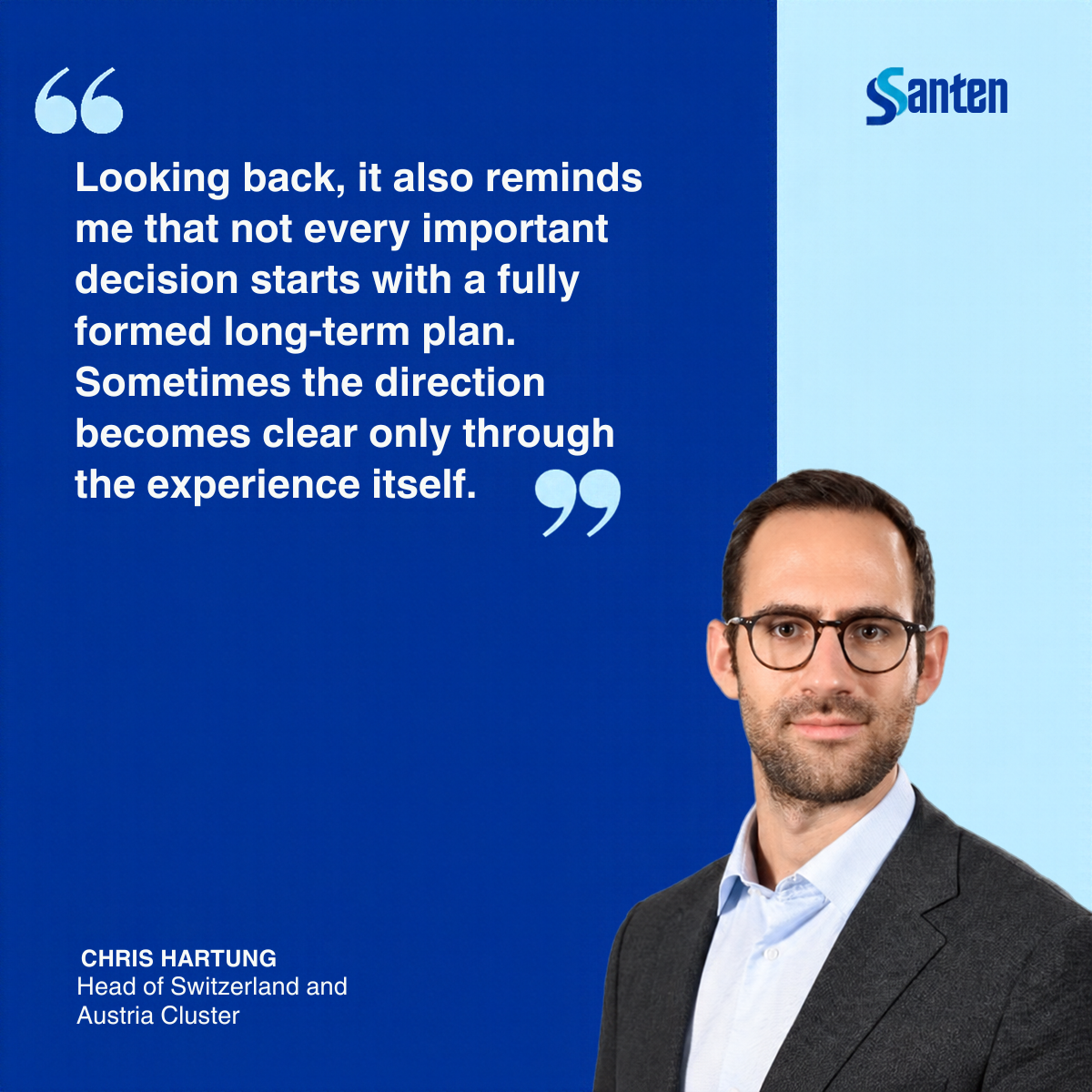
Lo que empezó como un primer paso profesional se convirtió poco a poco en una carrera y en una verdadera pasión. Mirando atrás, también me recuerda que no todas las decisiones importantes comienzan con un plan de largo plazo perfectamente definido. A veces, la dirección solo se vuelve clara a través de la propia experiencia.
3. Has pasado de ser Chief of Staff EMEA a liderar el Cluster Suiza y Austria en Santen. ¿Qué ha cambiado más en tu día a día con esta transición? ¿Y qué has descubierto sobre ti mismo al pasar de acompañar la estrategia a tener que liderarla?
Como Chief of Staff, gran parte de mi trabajo se centraba en la perspectiva regional: ayudar a traducir las prioridades estratégicas en estructuras, gobernanza y formas de trabajo más claras. El paso al rol de responsable del clúster me acercó mucho más a los clientes, a la realidad de los mercados y a las consecuencias prácticas de nuestras decisiones.
El mayor cambio fue la inmediatez de la responsabilidad. Un plan que parece convincente sobre el papel tiene que funcionar también para los clientes, los pacientes y el equipo que lo lleva a la práctica. He desarrollado una valoración mucho más profunda del conocimiento que existe en los equipos locales y de la importancia de estar cerca de quienes mejor comprenden el mercado.
También he aprendido que mi función no consiste en tener todas las respuestas. Consiste en aportar dirección, formular las preguntas adecuadas, eliminar obstáculos y crear las condiciones para que el equipo pueda tomar buenas decisiones y avanzar unido.
Me siento orgulloso de que el equipo haya logrado un crecimiento de doble dígito, pero lo más relevante es cómo se consiguió ese progreso: mediante el compromiso, la colaboración y una ambición compartida de llegar a más pacientes. La experiencia me ha hecho más consciente tanto de la responsabilidad del liderazgo como de cuánto depende el éxito de la contribución de los demás.
4. Has pasado por distintos roles, equipos y niveles de responsabilidad. ¿Hay alguna habilidad que nunca imaginaste que acabaría siendo tan importante en tu carrera? ¿O alguna que hayas tenido que aprender sobre la marcha, sin manual de instrucciones?
Liderar en la incertidumbre se ha convertido en una de las capacidades más importantes que he tenido que desarrollar. En nuestro sector, muchas decisiones deben tomarse antes de conocer todas las variables, especialmente en ámbitos como la competencia, la regulación, el acceso al mercado y los lanzamientos.
Antes pensaba que liderar en esos momentos significaba transmitir certeza. Hoy creo que se trata más bien de ser transparente sobre lo que sabemos, lo que todavía no sabemos y por qué elegimos una determinada dirección. El equipo suele aportar perspectivas que mejoran esa dirección, por lo que crear espacio para el debate y el cuestionamiento es esencial.
La certeza puede ser poco frecuente, pero aun así podemos aportar claridad, tomar decisiones reflexionadas y adaptarnos cuando aparece nueva información. Sigo aprendiendo a equilibrar la convicción con la apertura y a ayudar al equipo a avanzar sin fingir que ya disponemos de todas las respuestas.
5. Si hoy pudieras redefinir qué significa para ti tener éxito profesional, ¿qué incluirías en esa definición que quizá no habrías considerado al comienzo de tu carrera?
Al principio de mi carrera, asociaba el éxito mucho más con los cargos, la progresión, la rapidez con la que podía alcanzar el siguiente paso y el hecho de tener la respuesta correcta. Con el tiempo, esa definición ha cambiado.
Hoy, el éxito está más relacionado con la diferencia que creamos para los pacientes y con que las personas que nos rodean tengan la oportunidad de crecer y contribuir.
En uno de los primeros equipos que lideré trabajé con un recién graduado que aportaba una enorme curiosidad y motivación. Tuve la oportunidad de apoyar su desarrollo, pero también aprendí mucho observando cómo ganaba confianza, asumía responsabilidades y desarrollaba su propio enfoque. Ver a las personas avanzar más allá de lo que inicialmente creían posible sigue siendo una de las partes más gratificantes del liderazgo para mí.
Los logros individuales siguen importando, pero facilitar un progreso que continúa más allá de la contribución propia es una forma de éxito más duradera.
6. Ahora cuéntanos al menos una cosa en la que seas realmente malo…
El interiorismo. Mi mujer y yo nos mudamos recientemente, y enseguida encontramos nuestros papeles: yo me encargo de la parte práctica, de planificar y montar las cosas. Ella tiene el ojo para la armonía, los colores y el estilo.
Puedo pasar horas estructurando un problema complejo en el trabajo, pero cuando se trata de elegir entre dos cojines, he aprendido que lo mejor es confiar en la experta de casa.
1. You have Spanish and German roots and have developed your career in an international environment. What has that combination of cultures given you? Is there something from your Spanish side and something from your German side that coexist in you… or sometimes compete with each other?
Whenever I introduce myself as Spanish-German, someone tells me that it has to be one or the other. My mother is Spanish, my father is German, and I grew up in Germany with both languages and cultures at home.
Growing up with both cultures has influenced me, although probably in more subtle ways than I always recognise. I value structure, preparation and clarity, but I have also learned how important relationships and trust are when you want to turn plans into results.
Working at Santen added another perspective. Elements of Japanese business culture, including respect, precision and long-term thinking, resonated with parts of how I had grown up. At the same time, working across cultures remains a continuous learning experience. It regularly reminds me to listen first, avoid assumptions and adapt my approach to the people and context around me.
2. Looking back over your career, was there a decision or moment that changed its direction and, in retrospect, proved more important than you imagined at the time?
One of the most important decisions was joining a strategy consultancy focused on life sciences straight out of university. At the time, my aim was simply to start in consulting and learn how to approach complex problems. I did not yet realise how strongly the focus on life sciences would shape everything that followed.
I have always been curious about how things work, what sits behind them and why they work the way they do. The science behind medicines captured that curiosity completely. At one point, I even seriously considered going back to study medicine. Instead, I found a different way to contribute: helping organisations bring valuable treatments to the people who need them.
What began as a first professional step gradually became a career and a genuine passion. Looking back, it also reminds me that not every important decision starts with a fully formed long-term plan. Sometimes the direction becomes clear only through the experience itself.
3. You moved from being Chief of Staff EMEA to leading Santen’s Switzerland and Austria Cluster. What has changed most in your day-to-day work with this transition? And what have you discovered about yourself in moving from supporting strategy to having to lead it?
As Chief of Staff, much of my work focused on the regional perspective: helping translate strategic priorities into clearer structures, governance and ways of working. Moving into the cluster role brought me much closer to customers, market realities and the practical consequences of our decisions.
The biggest change was the immediacy of the responsibility. A plan that looks convincing on paper still needs to work for customers, patients and the team implementing it. I have gained a much deeper appreciation for the knowledge within country teams and for the importance of staying close to the people who understand the market best.
I have also learned that my role is not to have every answer. It is to provide direction, ask the right questions, remove obstacles and create the conditions in which the team can make good decisions and move forward together.
I am proud that the team has delivered double-digit growth, but the more meaningful point is how that progress was achieved: through commitment, collaboration and a shared ambition to reach more patients. The experience has made me more conscious of both the responsibility of leadership and how much success depends on the contribution of others.
4. You have worked across different roles, teams and levels of responsibility. Is there a skill you never imagined would become so important in your career? Or one you had to learn along the way, without an instruction manual?
Leading through ambiguity has become one of the most important skills I have had to develop. In our industry, decisions often need to be made before every variable is known, particularly around competition, regulation, market access and launches.
I used to think that leadership in those moments meant appearing certain. I now believe it is more about being transparent about what we know, what we do not yet know and why we are choosing a particular direction. The team often holds perspectives that improve that direction, so creating space for challenge and discussion is essential.
Certainty may be rare, but we can still create clarity, make thoughtful decisions and adjust when new information emerges. I am continuing to learn how to balance conviction with openness, and how to help a team move forward without pretending that every answer is already available.
5. If you could redefine today what professional success means to you, what would you include in that definition that you might not have considered at the beginning of your career?
Early in my career, I associated success much more with titles, progression, how quickly I could reach the next step and having the right answer. Over time, that definition has changed.
Today, success is more closely connected to the difference we create for patients and to whether the people around us have the opportunity to grow and contribute.
In one of the first teams I led, I worked with a recent graduate who brought enormous curiosity and motivation. I had the opportunity to support his development, but I also learned a great deal from watching him build confidence, take ownership and develop his own approach. Seeing people progress beyond what they initially thought possible remains one of the most rewarding parts of leadership for me.
Individual achievements still matter, but enabling progress that continues beyond your own contribution is a more lasting form of success.
6. Now tell us at least one thing you are really bad at…
Interior design. My wife and I recently moved, and we quickly found our roles: I take care of the practical side, planning and putting things together. She has the eye for harmony, colours and style.
I can spend hours structuring a complex problem at work, but when it comes to choosing between two cushions, I have learned that it is best to trust the expert at home.